The Basics of Tilting Mobile Shower Commode Chairs
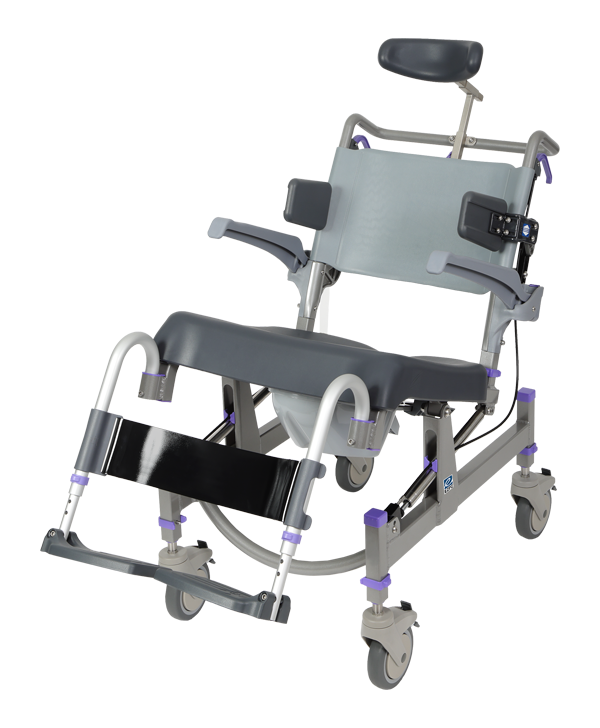
Tilt MSCCs are versatile, multi-functional mobility aids designed to assist individuals with various levels of mobility issues. These chairs are typically used in the bathroom, offering a safe and comfortable solution for showering, toileting, and hygiene routines. They come with a variety of features and benefits that make them an essential tool for end users and their caregivers.
1. Tilt Functionality
One of the standout features of these chairs is the tilt mechanism. This function allows the user to tilt the chair back while maintaining a consistent, ergonomically correct seated position. This is especially beneficial for individuals with limited trunk control or those needing assistance in maintaining proper posture. Tilting the chair ensures even weight distribution, reduces the risk of pressure sores, and provides a comfortable experience during tasks like showering, hair washing, and toileting. Caregivers can easily adjust the chair's tilt angle, making it a more comfortable experience for both the user and the caregiver.
2. Easy Maneuverability
Tilt MSCCs are designed with large, sturdy wheels that allow for easy maneuverability in tight bathroom spaces. These wheels often come with locking features to ensure safety during transfers and while showering. Some models may also have swivel front casters for added flexibility, allowing for smooth navigation from the user’s bed to the bathroom.
3. Adjustable Features
These chairs offer various customization options to cater to individual needs. Features like adjustable headrests, armrests, footrests, and seat heights can be tailored to provide optimal comfort and support for each user and their caregiver.
4. Hygienic and Safety
Tilt MSCCs are constructed using materials that are resistant to water and moisture, ensuring they are easy to clean and maintain. They often come with waterproof cushions and removable seat and backrest options that can be cleaned separately and are appropriate in settings where infection control practices are of high priority. Additionally, many models include safety features such as secure seat belts and anti-tipping mechanisms, providing peace of mind to both users and caregivers during shower and toileting routines.
5. Versatility
These chairs come in various styles and sizes to cater to users' unique needs. Some models are designed to be compact and easily fit into smaller bathrooms, while others offer bariatric options for individuals who require additional support. They can be used in the shower, over the toilet, or as a standalone commode, making them versatile and cost-effective solutions for individuals with limited mobility. The diverse range of options ensures that everyone can find a chair that suits their specific needs.
It's essential to emphasize that not all tilting MSCCs are created equal. Manufacturers prioritize various components, features, and materials, resulting in a wide array of options available in the market. Unfortunately, not all these options will be suitable or appropriate for the end-user’s needs. Therefore, understanding what to seek in terms of clinical benefits associated with specific features, components, and materials is vital when offering recommendations for an end-user's MSCC.
Tilting Mobile Shower Commode Chairs (MSCCs) by Raz Designs Inc.
Raz Designs Inc., a manufacturer renowned for seamlessly integrating product functionality with clinical benefits, produces tilting MSCCs that are meticulously tailored to address the unique needs of end-users. They offer an extensive range of options and accessories specifically designed to address various seating concerns, including those that are complex. Raz was founded in Toronto, Ontario, in 2004 by CEO and Co-Founder David Harding and President and Co-Founder Nelson Pang, both of whom have over 40 years of industry experience. Manufactured in the Raz factory in Toronto, Ontario, Raz MSCCs were ingeniously designed to bridge a significant gap in the industry: providing highly customizable, configurable, and adjustable mobile shower commode chairs to the end user. Motion Composites is proud to be the exclusive Canadian distributor of Raz Design Inc. products.
Raz MSCCs are available in a variety of models, ensuring that individuals with diverse needs can find a suitable option that accommodates their unique requirements. Some models offer tilt, recline, self-propelling accessibility, options for pediatric or smaller adults, bariatric options, folding for transport, etc. Individuals in need of extra stability and positioning options can choose from a range of accessories, including lateral supports, chest belts, headrests, etc. These accessories can be easily moved out of the way to prevent a sling from becoming entangled during transfers with a mechanical lift. Raz also takes pride in manufacturing custom frames, seats, and accessories when the off-the-shelf products they offer are unsuitable for the end user. With Raz, the possibilities are truly boundless. Below, we have provided a comprehensive overview of the tilting MSCC models available from Raz. Click here to be redirected to the products page on the website or on each of the models below for more information.
RAZ-ART ATTENDANT ROTATIONAL TILT
Space constraints can often be challenging in both home and facility showers, particularly in older showers with smaller dimensions, making it cumbersome to accommodate and fully tilt a MSCC. For these situations, the Raz-ART stands as an excellent choice. The Raz-ART, short for Attendant Rotational Tilt, offers a remarkable solution by providing a generous 40° tilt range, ensuring enhanced pressure relief and comfort. What truly sets it apart is its ingenious frame design, featuring a patented dual-arc orbital tilt system, which not only boasts the smallest footprint but also demands the least effort for tilting when compared to any other chair on the market. Its practicality extends further with two ranges of tool-less height adjustment (20"-23" and 24"-27%), thanks to its innovative aluminum frame. Additionally, it addresses a common issue in commode chair designs with a patent-pending tilt-locking system that eliminates cable "looping." The Raz-ART comes equipped with a range of standard features, including the Ischial & Pelvic Alignment System (IPAS), adjustable-tension back upholstery, a molded headrest and fixture, 5" dual-locking casters, flip-up padded armrests, and a commode pan. The aluminum frame, designed for easy cleaning, fits securely over most toilets and allows effortless side and front access for both users and attendants. The Raz-ART seamlessly blends convenience and durability, making it an exceptional choice for a variety of shower settings.
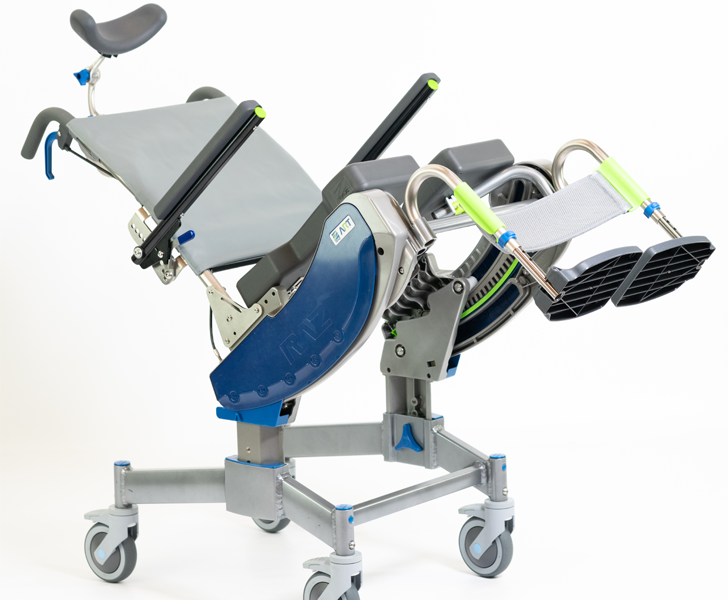
RAZ-AT ATTENDANT TILT
The very first of the tilt MSCC in the Raz family, the well-loved Raz-AT (Attendant Tilt), offers a 40° tilt range for enhanced pressure relief and comfort. Its innovative frame design utilizes locking gas springs, making it one of the easiest-to-operate tilting MSCCs. The Raz-AT includes several standard features such as the Ischial & Pelvic Alignment System (IPAS), 4" of height adjustment, adjustable-tension back upholstery, molded headrest and fixture, 5" dual-locking casters, flip-up padded armrests, and a commode pan. The polished stainless-steel frame is easy to clean, fits over most toilets, and allows user and attendant access from the side and front. It boasts a weight capacity of 350 lbs and comes in widths of 16", 18", and 20". Additional positioning support can be added with accessories like optional laterals, and the chair is also available with a recline feature. Furthermore, the stainless-steel construction comes with a lifetime warranty against corrosion.
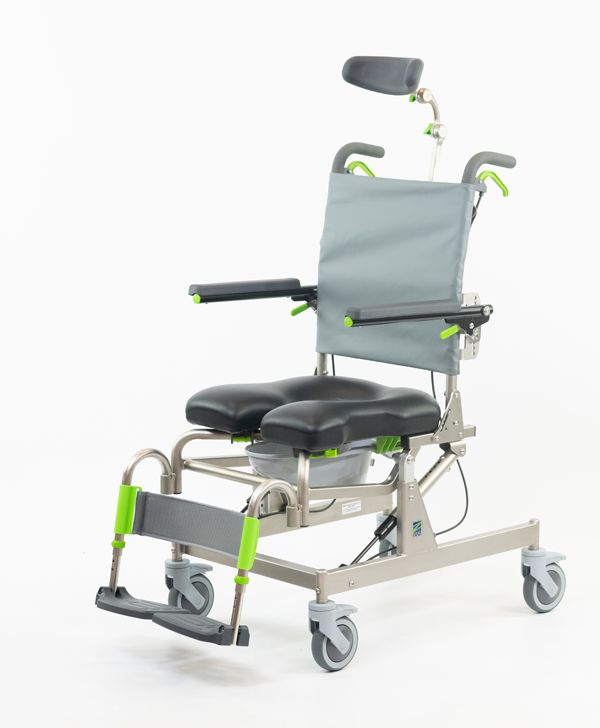
RAZ-CAT COMPACT ATTENDANT TILT
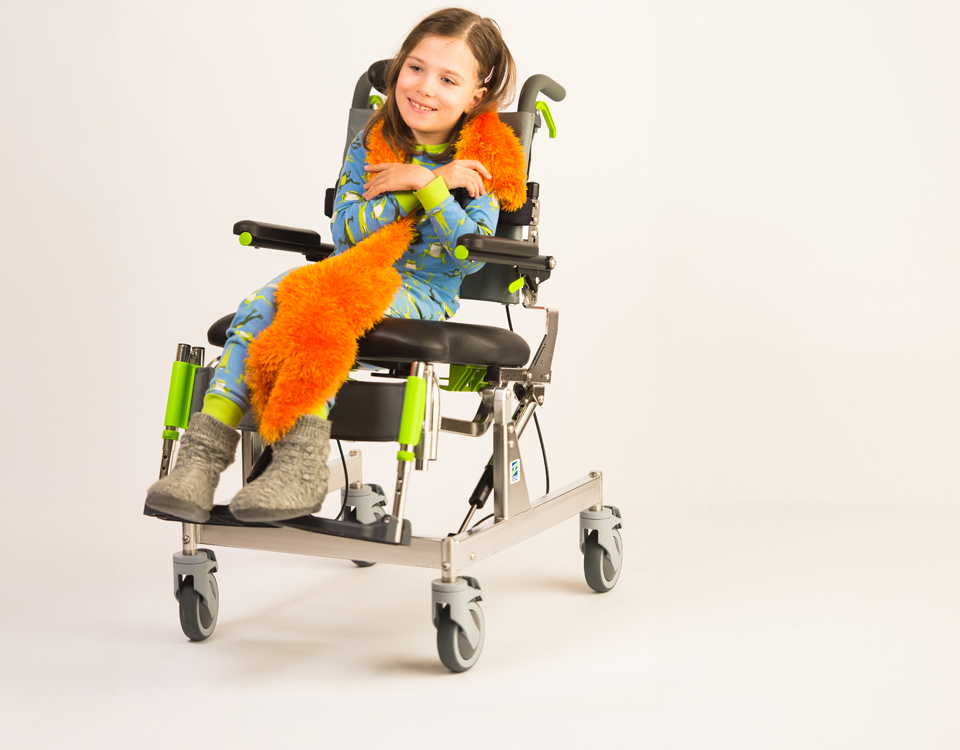
The Raz-CAT (Compact Attendant Tilt) MSCC is a compact version of the Raz-AT, designed to better accommodate pediatrics, adolescents, or smaller adults with specific needs. It retains the 18" width of the Raz-AT to allow positioning over a toilet. The Raz-CAT boasts several key adjustments that set it apart for accommodating pediatrics, adolescents, and smaller adults. Its base frame is 3" shorter, enhancing maneuverability, while the seat frame depth is reduced.
A depth-adjustable backrest permits depths ranging from 12" to 15" (to the front of the frame), expandable up to 17" when the front of the seat overhangs the frame. The standard seat is equipped with an elongated, more narrow aperture, catering to seat depths from 12" to 15". Custom seats are also available for tailored support. In addition, the depth-adjustable backrest supports growth capabilities, a vital feature for pediatric users. Back frames are customizable in widths of 14", 16", and 18", and the available back heights include 15" and 18". The chair's frame and hardware are constructed from stainless steel, offering a lifetime warranty against corrosion, ensuring long-term durability and adaptability to evolving needs. These features make the Raz-CAT an ideal choice for individuals who require a smaller, more adjustable seating system with a focus on durability and adaptability to changing needs.
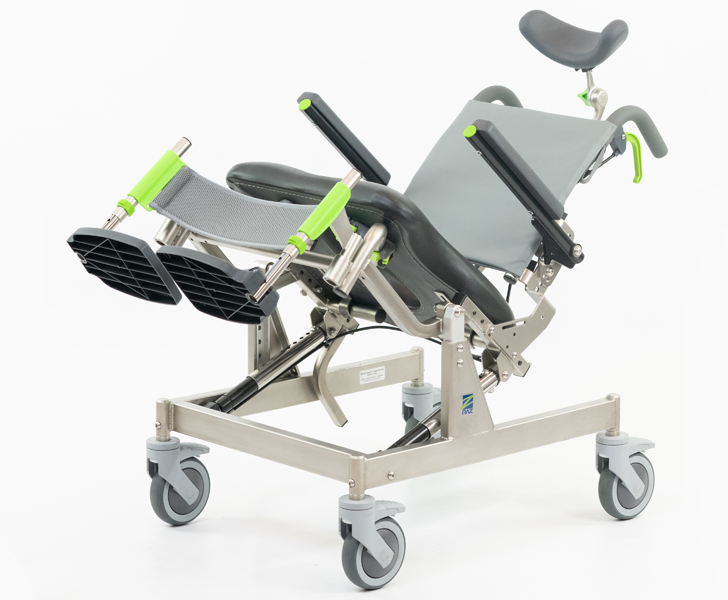
RAZ-AT600 ATTENDANT TILT
The Raz-AT600 is part of Raz’s Razbari line of bariatric mobile shower commode chairs. It is a robust heavy duty MSCC designed for users with a maximum weight capacity of up to 605 lbs. It features a sturdy stainless-steel frame and components, ensuring durability, and is backed by a lifetime warranty against corrosion. With an impressive 25° tilt range, this chair provides versatile positioning options for bariatric users. Equipped with four locking 6" (150mm) casters and a convenient commode pan, it offers functional mobility and ease of use. The chair incorporates a Weight Assist Spring System (WASS), available in two weight ranges and adjustable to accommodate the user's weight and Center of Mass (CoM), making tilt operations effortless for attendants. Included are a headrest pad (10" x 4"), a stainless-steel headrest fixture, Tilt Assist Pedal, and heavy-duty footrests (Z709N). Furthermore, the Raz-AT600 can accommodate users with seat widths ranging from 22" to 30".
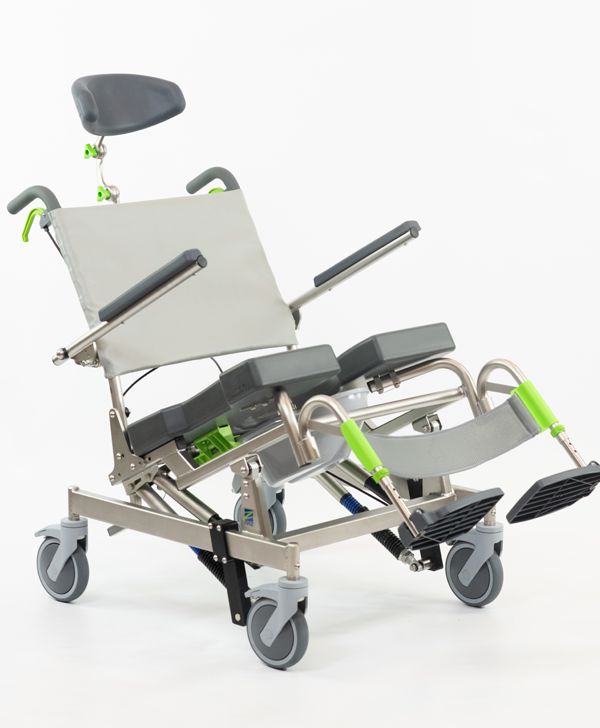
EZPZ-AT ATTENDANT TILT
Introducing the latest addition to the Raz tilt family, the EZPZ-AT MSCC is a versatile and user-friendly solution designed to meet the mobility challenges of a wide range of users. It boasts an easy-to-operate tilt function, offering a maximum tilt of 35° for effective pressure redistribution. It includes an ergonomically contoured composite seat, with an optional soft seat overlay available. The chair's durable design incorporates a corrosion-resistant aluminum frame, ensuring long-lasting reliability, and features dual-locking casters for seamless maneuverability across various surfaces. Additional features include: an adjustable seat-to-floor height, 5° anterior tilt, soft and flexible back support, and flip-up arm supports. The four dual-locking, 5" casters ensure smooth mobility. The chair also offers a head support, tool-less height adjustment, a corrosion-resistant aluminum frame, an ergonomic commode pan with a lid, and a weight capacity of 330 lbs. The Raz EZPZ-AT is an affordable yet high-quality choice, with a variety of options and accessories available to cater to individual needs.
For more information on the clinical benefits of Raz MSCCs and a general overview of their products and accessories, click here.
Clinical Benefits of Tilt in Mobile Shower Commode Chairs
When choosing between an upright or tilt MSCC, a significant question arises: When, from a clinical perspective, should one opt for a tilting MSCC? When an individual is unable to reposition themselves when seated to offload pressure from their buttocks or unable to maintain an upright posture while sitting due to decreased trunk strength, they are typically prescribed a tilting wheelchair for mobility. This option promotes safety, independence, and prevents injuries. For these individuals, these positioning concerns remain consistent across various seating surfaces, as the principles of effective positioning apply universally. Consequently, individuals utilizing a tilting wheelchair should also consider utilizing a MSCC equipped with tilt capabilities. There are many clinical benefits to using a tilting MSCC, including:
- Enhanced Dignity and Independence: These chairs provide users with mobility challenges, and the means to uphold personal hygiene with dignity and independence. Whether they require maximum assistance or can manage on their own, the ability to use the toilet rather than relying on incontinence products or to enjoy a shower in place of a bed bath fosters a profound sense of normalcy. It further contributes to the preservation of their dignity, self-esteem, and overall quality of life.
- Toileting/Showering: Tilting MSCCs can be positioned over toilets, enabling users who cannot sit safely on the toilet to engage in toileting activities. Furthermore, these chairs seamlessly transition into the shower, allowing individuals to maintain personal hygiene effectively and comfortably. The tilt feature plays a pivotal role in ensuring the proper alignment of the ischial tuberosities within the aperture, thereby granting both the user and their caregiver unobstructed access to the perineal area.
- Caregiver Safety: Caregivers experience significant advantages through the ergonomic design and adjustability of tilting MSCCs, reducing the physical demands of assisting individuals in their personal care routines. The ability to adjust the seat-to-floor height is of paramount importance to caregivers, effectively minimizing the risk of injury during tasks involving bending, lifting, or transfers. Furthermore, the incorporation of tilt functionality enables caregivers to effortlessly position the user on the mobile shower commode chair, ensuring that their ischial tuberosities rest comfortably within the seat's aperture. This not only enhances user comfort but also grants caregivers improved access to providing perineal care with greater ease and precision.
- Positioning and Safety: Users with specific postural or medical needs may benefit from a MSCC with tilt functionality. These chairs not only enhance safety during toileting and showering but also mitigate the risk of users sliding forward or leaning in unintended directions. The tilt feature, combined with the assistance of gravity when positioned at an angle, works in tandem to promote a stable and upright trunk posture, ultimately ensuring the user's safety and comfort during these essential activities.
- Pressure Management: Tilting MSCCs are excellent for individuals at risk of pressure sores or existing skin conditions. The tilting mechanism serves to effectively redistribute body weight and pressure, substantially reducing the risk of developing pressure ulcers. Moreover, MSCCs with both tilt and recline functionality offer substantial pressure-relieving advantages. In accordance with the RESNA (2015) clinical practice guidelines, a tilt exceeding 25 degrees is recommended to achieve optimal pressure relief at the ischial tuberosities. Research also highlights that the most significant reductions in pressure occur when tilt and recline functions are combined, whether at a tilt of 35° paired with a 100° recline or a tilt ranging from 15-25° coupled with a 120° recline (RESNA, 2015). These findings underscore the critical role of tilt and recline features in mitigating pressure-related issues in seating. The adjustability of the armrests, footrests, and back support also plays a significant role in pressure management. When these components are adjusted to accommodate an individual’s unique positioning needs, pressure is evenly distributed throughout the body rather than being loaded on bony prominences like the ischial tuberosities, coccyx/sacrum, and femurs.
- Comfort and Sitting Tolerance: Tilt MSCCs provide added comfort during extended bathroom activities, reducing strain and discomfort associated with maintaining a static sitting position. This can be especially beneficial for individuals who are sitting on the MSCC for long durations and require changes in the degree of tilt to decrease pressure, pain, and increase sitting tolerance.
Ultimately, the choice to use a MSCC that tilts will depend on the user's specific needs, medical condition, and the level of customization required for their comfort and positioning. A healthcare professional such as an Occupational Therapist or Physiotherapist can play a pivotal role in assessing the end user and recommending the most suitable MSCC option based on their needs.
Conclusion
Tilting MSCCs have significantly improved the quality of life for individuals with mobility challenges and their caregivers. With their innovative features, adaptability, and focus on safety and hygiene, these chairs have become essential tools for maintaining personal care routines and promoting independence. When it comes to providing a safer, more comfortable, and dignified bathroom experience, tilt MSCC are truly a game-changer.
References
Rehabilitation Engineering & Assistive Technology Society of North America (RESNA). 2015.
Position on the Application of Tilt, Recline, and Elevating Legrests for Wheelchairs Literature Update [position paper]. Retrieved from: RESNA: www.resna.org/resources/position_papers.dot




.jpg)