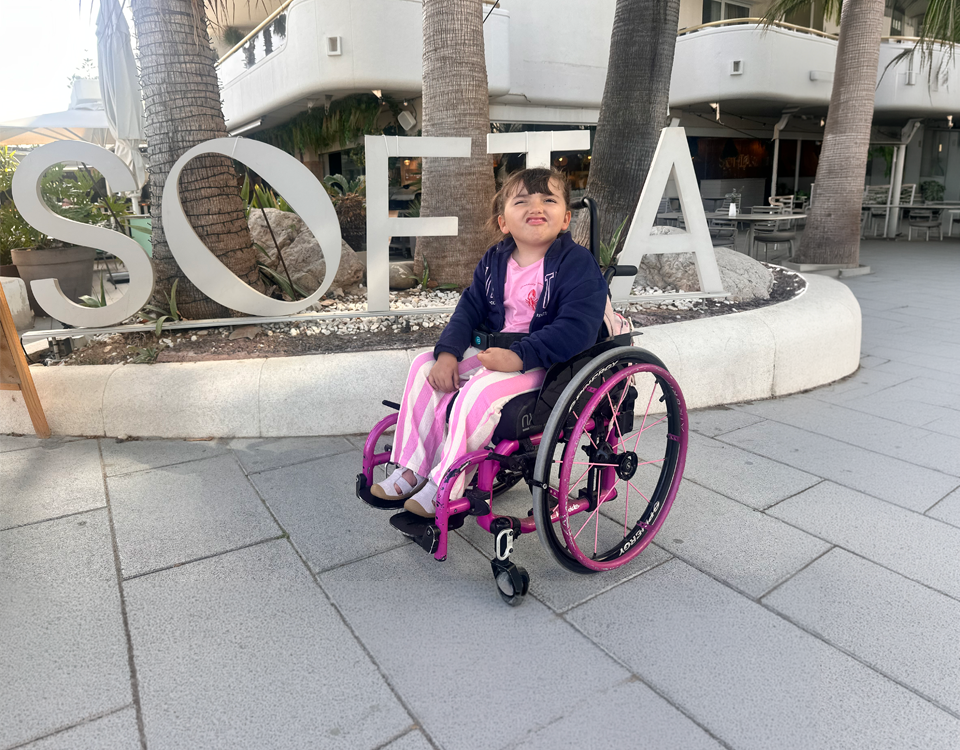
From a very young age, her personality has been impossible to miss! She has always been super expressive, warm, and full of an energy that naturally draws others to her. Her mom describes her as a true little ray of sunshine, and it’s easy to see why.
Sofia’s journey, however, is far from ordinary. At only 13 months, her parents learned that something was not developing as expected. After several years of uncertainty, the diagnosis came at two and a half years old: an extremely rare genetic disease affecting her brain, leading to spasticity and significant mobility limitations. At that time, the medical outlook was bleak, with very limited expectations for her future.
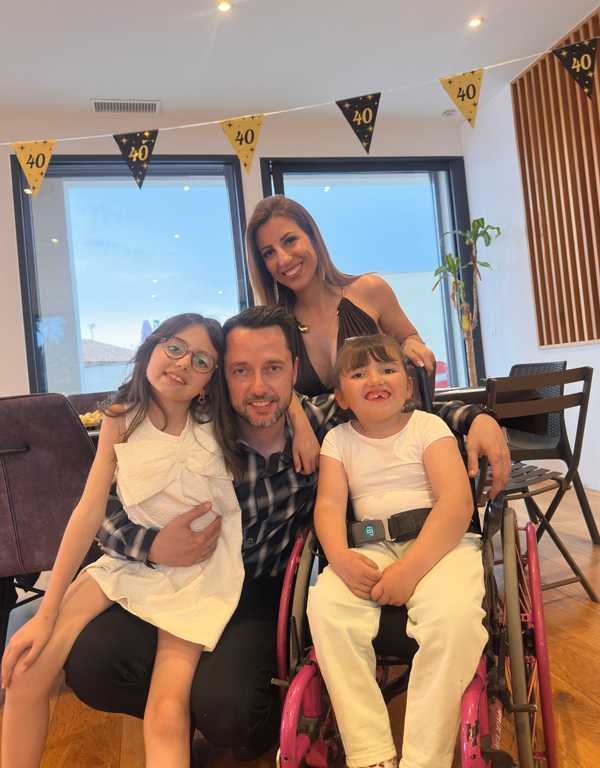
For her family, the diagnosis was never a definition. What they saw was a curious, engaged child deeply eager to interact with the world. So, they made a defining choice: to focus on what Sofia can do and to create opportunities for her to develop her independence in her own way. This allowed Sofia to surpass all odds, and today she goes to school, continues working hard in therapy, and fully participates in her daily life with confidence, curiosity, and joy, which is exactly what any parent would want for their kids.
Today, we are meeting with her mom, Ana Leite Freitas, a determined woman who, together with her husband, has consistently fought to secure the best possible opportunities for their daughter. From accessing education and therapies to navigating complex healthcare and mobility decisions, she focuses on one thing only: enabling Sofia’s independence and participation in everyday life.
Interview:
Motion Composites: Can you tell us a bit about Sofia’s daily life? What does a typical day look like?
Ana Leite Freitas: Of course. First, it’s important to know that getting to where she is today has been a very long fight.
We had to fight for her right to go to school. We had to fight for her to have proper medical follow-up, because at the beginning, doctors told us it wasn’t necessary, that she wouldn’t progress anyway, so follow-up wasn’t needed. And when it comes to therapies, she never really had support from the public system, simply because there was no place for her.
Today, Sofia finally has a life that resembles that of a child her age, with adaptations, of course.
She attends a normal school. She repeated the last year of kindergarten, so she is still in preschool, but she’s fully integrated. She eats at the cafeteria with her friends.
Alongside this, she follows an intensive rehabilitation program: four times a week, she has occupational therapy, physiotherapy, speech therapy, and she is also learning to communicate using pictograms.
On weekends, we try to enjoy simple family moments: outings, games, and normal everyday activities. And during holidays, we often travel abroad for intensive rehabilitation periods. We go in particular to Barcelona, to a specialized center where many French families gather. There, Sofia does up to four hours of therapy per day for one to two weeks.
MC: Do you find it easy to travel with the HELIO Kids C?
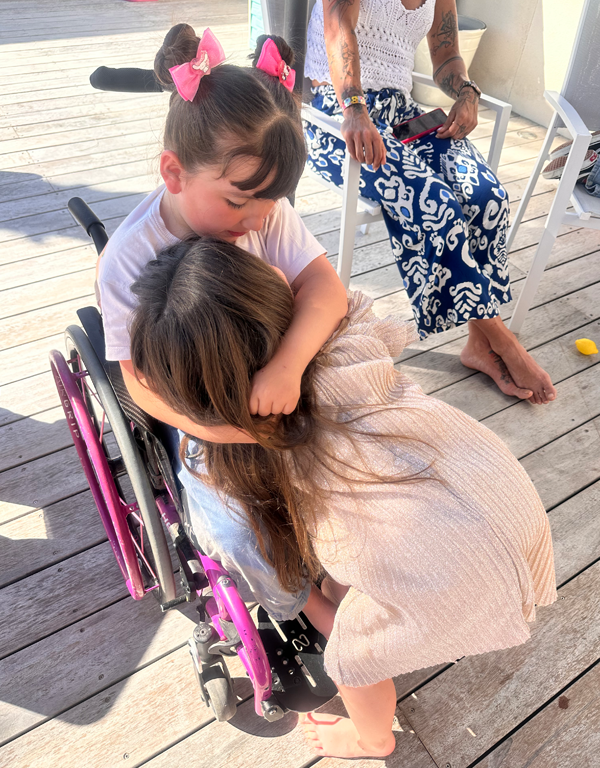
ALF: I mostly travel by car. I’ve lived in France for 13 years, but I’m Portuguese, so I also travel to Portugal often. And honestly, whether by car or plane, it’s very easy.
When I’m in Lisbon, I take Ubers. And even with small cars, like a Citroën C1, or a Fiat 500, the HELIO Kids C fits easily in the trunk.
What I really like is that I never have to wonder whether we can go out or not because the wheelchair is too complicated to transport. The HELIO Kids C is easy to maneuver, foldable, and fits into any trunk. It’s truly easy to take everywhere. It is light, easy to handle, and it doesn’t limit our mobility.
MC: What led you to choose the HELIO Kids C?
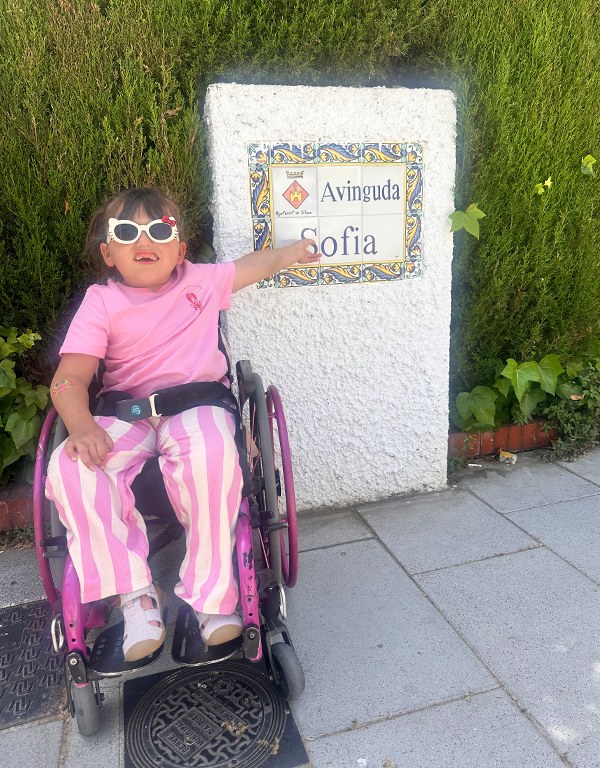
ALF: I had a very simple idea: I wanted a wheelchair with exactly the same criteria as a stroller. Let me explain.
When you have a baby, you often look for the best stroller, the one with everything: the bassinet, accessories, comfort, but it can become very heavy and bulky. Strollers can become a burden in daily life, literally and figuratively. At some point, you switch to a lightweight stroller because you want to keep living normally.
For Sofia, I wanted exactly that: something that would not limit our daily life. A lightweight, maneuverable, foldable chair that is easy to transport, and above all, adapted to a child.
But the solutions offered did not meet my needs. In medical supply stores, I was offered either non-folding wheelchairs, which can require changing cars and add major costs, or electric solutions. And I didn’t want that. I wanted my daughter to stay active, keep moving, put in effort, and participate in her rehabilitation. For me, independence for Sofia meant remaining active, not passive.
I felt like people didn’t really understand what I was looking for. I even ended up being seen as “the difficult customer” because nothing suited me. But I knew there had to be a solution.
That’s when I started my own research and discovered carbon fiber wheelchairs, lightweight and foldable, and specifically Motion Composites. At that moment, I thought: “This is exactly what I’m looking for.” After all, a wheelchair is not just another product, it is my child’s legs, what gives her independence every day.
In the end, I was able to try an adult model to get a sense of it. And I made a decision that wasn’t easy, even though the professionals around us were cautious. They had doubts, and I understand why. But I chose to trust my intuition and Sofia’s needs.
Looking back, I have no regrets.
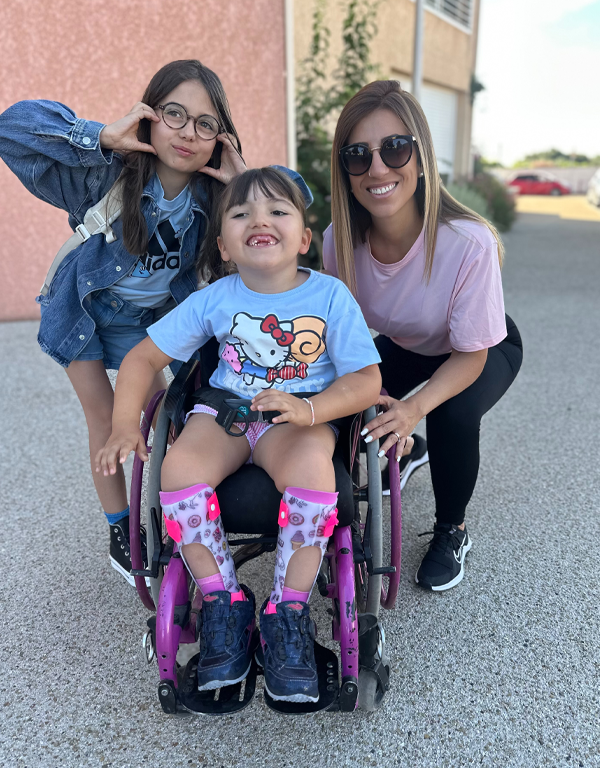
The HELIO Kids C has deeply changed her daily life. And when people ask me what it changed… it’s like asking someone who was given the ability to walk what it changed in their life.
This chair gave her autonomy, confidence, and pride. It helped her progress both motorically and cognitively. And most importantly, it allowed her to fully participate in life around her.
Of course, nothing is perfect; the world is not yet fully accessible. But in her daily life, Sofia is free to move, explore, choose, and most importantly, be an active and happy child.
And for us, that’s what matters most.
MC: As a mother, what has the HELIO Kids C changed in your daily life?
ALF: At first, I was not accepting the fact that my daughter would need to use a wheelchair. There is a period of acceptance, like for many parents.
At first, I saw the wheelchair as a very negative symbol, almost a restriction. Today, it’s completely different.
Today, when I see what the HELIO Kids C has brought to my daughter, I see her autonomy, her progress, her happiness. And I also see what it has changed for me, as a mother.
It has brought me pride, joy, and above all, a real sense of relief in daily life. Because practically, it makes many things easier.
In everyday situations, everything becomes simpler. For example, at the supermarket: I have the cart, she is next to me in her HELIO Kids C. She is autonomous, she participates, she is active in her environment. I don’t have to manage a bulky stroller, and she is not passive in the situation.
Of course, she is still a child, she moves, explores, sometimes she runs off a bit like all children, but being in a wheelchair also gives her real independence in many daily moments.
And for me, as a mother, that changes everything. It’s not just easier. It’s the feeling of seeing her free, involved, and fully an active participant in her life.
MC: How important is it for you to have a wheelchair that adapts to Sofia’s growth?
ALF: It is extremely important. A wheelchair is not just a piece of equipment; it is an essential tool in her daily life. And among all medical equipment, it is probably the most important, because it directly represents her independence.
And this independence also comes with a high cost. Having a growth kit makes a huge difference. Without it, we would often need to replace wheelchairs every two years, which would be a very heavy financial burden for families.
MC: What would you say to other parents in a similar situation who need to choose a wheelchair for their child?
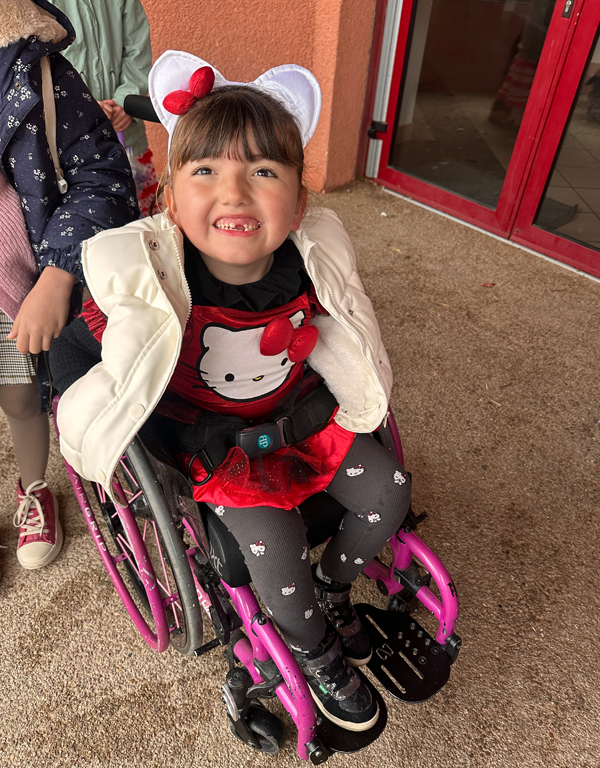
ALF: I would tell them to choose a wheelchair that has the least possible impact on their daily life, and that allows them to continue living as normally as possible.
As soon as you start thinking: “With this chair I need to change my car,” or “I won’t be able to do this or that anymore,” that’s often where it becomes complicated.
For me, the most important choice is a wheelchair that allows you to live and enjoy life without becoming a constant constraint.
And that is exactly what the HELIO Kids C has given us.
Sofia’s story is proof that the right mobility equipment becomes far more than just tools. They become a way for kids to explore, learn, connect, and grow far beyond expectations!
We know the world is not perfect, and we still have a long way to go to make it accessible to everyone, but having the right equipment can help create opportunities and give users the independence they deserve, regardless of their age.
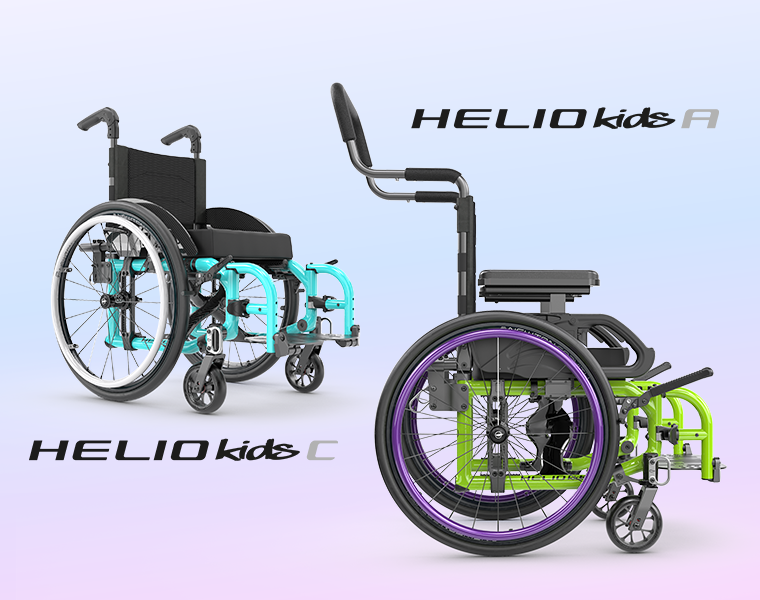
If you want to learn more about the HELIO Kids C, or the HELIO Kids A, click here!
Finally, we want to thank Ana for meeting with us and sharing their experience with the HELIO Kids C Wheelchair. We cannot wait to continue seeing all the adventures Sofia embarks on. Don’t forget to give them a follow here!