
Wishes for Wheels - RJ Roggeveen
Meet RJ Roggeveen, a third-year medical student living in Halifax, Nova Scotia, APEX C user, and disability advocate who loves to travel.
Meet RJ Roggeveen, a third-year medical student living in Halifax, Nova Scotia, APEX C user, and disability advocate who loves to travel.
You might have seen some of his social media posts, where he shares the realities of medical school as a wheelchair user, how adaptive technology helps him in his daily life, and what it means to him to be a disability advocate in Canada.
At Motion Composites, we understand that the right wheelchair, tailored to each user’s specific needs, can transform a user’s life. For RJ, struggling with a chair that didn’t quite fit made everyday tasks more challenging than they needed to be.
RJ was selected earlier this year as one of the recipients for the Wishes for Wheels Program, so of course, we had to meet with him to learn more about his experience with the program and his brand-new APEX Carbon Rigid Wheelchair.
Interview:
RJ: Yeah, so I’ve been a wheelchair user for almost four years now. It all started in the spring of 2021. Like a lot of people during that time, especially at the peak of COVID, getting access to rehab services was incredibly difficult.
I spent about eight months in a loaner chair that was really poorly fitted. Eventually, I received my APEX A, which was a fantastic first chair—but the ordering process was tough. Some of the measurements were incorrect, and because the rehab system was overwhelmed with inpatient care during COVID, I ended up working with an occupational therapist and a vendor who had never fitted or sold an active wheelchair. So, we were all learning together, but unfortunately, that meant my first chair wasn’t fitted as well as it should have been, especially the front frame.
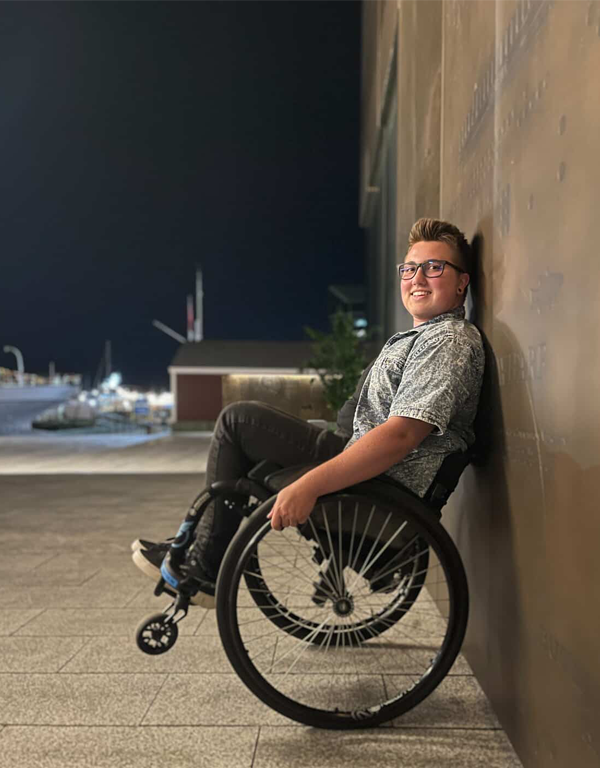
At one point, we even pulled in the frame by doing the “-2 inches” on the order form. It brought my legs way too far under the chair, far more than you can naturally keep them. That was a huge mistake on our end.
But even with those challenges, the chair still got me far. I travelled a lot with my APEX A, pushed it to its limits, learned how to go downstairs, and we really put it through its paces.
RJ: I was talking with Cindy, the rep out here. At first, we were discussing the EVO Rigid, a part of the EVO program, which allows you to change the frame of a rigid wheelchair. I wanted to know whether it would work for me because that front frame error in my old chair had been a struggle for three years. Making it really difficult to keep my feet on the footrest.
She prepared a quote for the EVO Rigid, and then mentioned the Wishes for Wheels Program, encouraging me to apply. I’d heard of it on social media but didn’t know the specifics.
After reviewing the criteria, I thought, “Why not?” A few months later, I received an email saying I’d been selected! I couldn’t believe it!
RJ: Super excited. The chair-ordering process made me a bit nervous. But mostly, I was thrilled. I had so many questions about the whole process, and the team answered them all within the first 24 hours!
RJ: Honestly, the application was very reasonable. I’ve talked to a lot of people since then who knew I got accepted and wanted to apply themselves. Compared to other grants or applications for mobility equipment, it was manageable. The questions were clear, and I was able to complete them in one sitting, which isn’t always the case with applications like this.
Before applying, Cindy suggested I meet with my vendor and occupational therapist to try out the APEX C and see how it could benefit me. I was fortunate to have an occupational therapist I’d worked with before and a trusted vendor, so setting up that appointment and trialling the chair was easy. Once the application was submitted, it was mostly a waiting game.
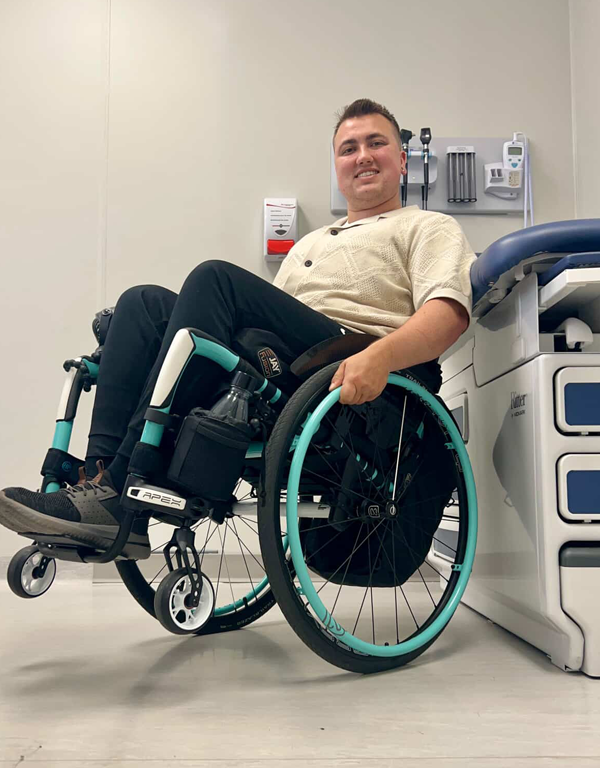
When I got the acceptance email, the team acted very quickly. Within a week, we were moving forward with ordering the chair. Doing the fitting beforehand made everything smooth. I had a few questions about the front frame angle, so I also consulted Chris Collins in the States, who uses this chair himself. His insights were really helpful. From acceptance to ordering, it took about a month, and then I just waited for the remaining pieces to arrive. Overall, it was one of the fastest chair ordering processes I’ve experienced.
RJ: On days when I’m using my manual APEX C, I roll to the hospital around 6:00 AM for rounds. My days are long; I get up at 5:00, roll to the hospital, and it’s a manageable workout without my power assist, which is excellent.
The typical day for a med student in my rotation is busy: prep charts, round on patients, see everyone briefly, then move to clinic around 8:30 AM. In the clinic, I see patients back-to-back, do physical exams, and review plans with my attending. This continues until around noon, with a short lunch break if I’m lucky. Afternoons involve either clinic or class, depending on the schedule, and finish around 5:00 or 6:00, then roll home.
Some days, I get a workout in; other days, I’m too tired. Evenings might include playing board games with my partner, extra studying, or a coffee while winding down. On top of that, I try to find time for social media, filming videos or engaging with the community whenever I can after class. It’s a full day, but I love what I do.
RJ: When I had the opportunity to switch to the APEX C, I didn’t expect the difference to be so dramatic. I thought it would be similar, just lighter, with a few changes to the seating and a better frame fit. But once I got it, I realized just how big that difference was. Part of it is simply that a new chair rolls better than a chair that’s been used for years, no matter how good the maintenance is.
With the APEX C, I haven’t even moved my power assist over yet. I will at some point, but I haven’t needed to. I’m currently in my clinical rotation, and I’ve been able to roll to the hospital without any power assist, something I absolutely could not do with my old chair. That’s been huge for me. It means I can get the exercise without being too exhausted to do my job afterward.
RJ: Absolutely. The weight difference is huge. The APEX C rolls smoother, and I notice the vibration damping quite a bit. Our sidewalks are rough here. I think part of why it feels easier to roll is that I feel less jolting every time I go over cracks or uneven surfaces.
The fit is just better, too, which makes transfers a lot easier. One of the biggest differences is the front frame design. The APEX C has a flat surface with clear grab points leading into the front-end angle. On the APEX A, I didn’t really have any grab points, so I was always balancing off my cushion to transfer. Now, I have a very solid point to hold onto, which has been incredibly helpful, especially in inaccessible spaces.
RJ: Yes, drastically. Having a super light wheelchair that’s well set up with proper seating and fit means I can spend 12 hours in it without needing long breaks. When I had my APEX A, it wasn’t as perfectly fitted, and spending a full shift in the chair was much harder. Now, with the APEX C, I can do my job all day, manage pressure relief as I go, and keep working without fatigue impacting my performance.
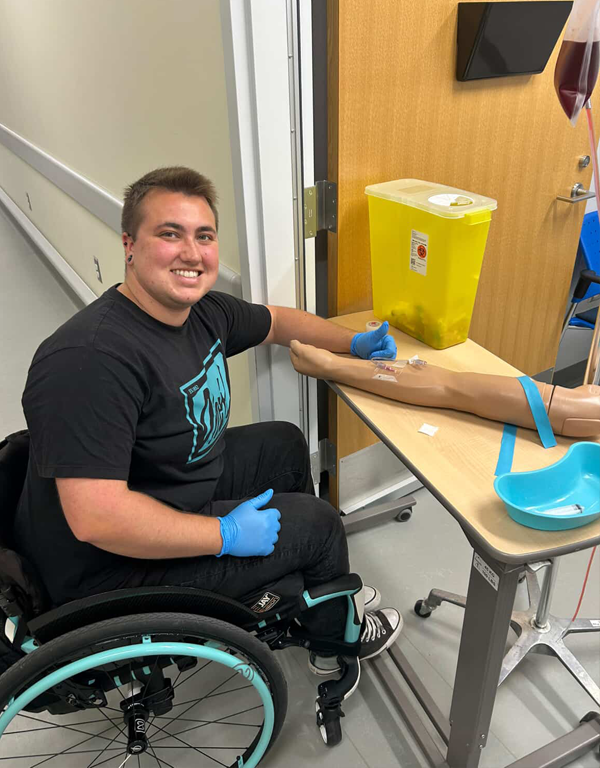
RJ: My best advice is to apply, because you never know if you might be selected. If you haven’t tried a Motion Composites wheelchair before, do a trial to make sure it’s actually beneficial for you. Doing a trial also helps you know what to write in your application because you can clearly explain why that specific Motion Composites wheelchair model would help you.
We want to thank RJ for taking the time to meet with us and share his experience with the Wishes for Wheels Program. We can't wait to see him travelling the world and sharing his med school adventures in his new APEX Carbon Fiber Rigid Wheelchair!
If you or someone you know uses a wheelchair and could benefit from a high-end ultralightweight manual chair, but don’t have the means to obtain one, we encourage you to apply for the Wishes for Wheels Program. The application is simple, straightforward, and can be completed entirely online.
Learn more about the Wishes for Wheels Program or apply today!